
A lot has already been said about project management, and plenty more will be said about it in the future. Still, let me add my two cents.
Wikipedia defines a project as “a type of assignment, typically involving research or design, that is carefully planned to achieve a specific objective.” Project Management Institute describes it as “a temporary endeavor undertaken to create a unique product, service, or result.” And David Allen brings it down to earth: a project is “any desired outcome that requires more than one action step to complete.”
I guess a project can be anything, really. Is my Pita Pan a project? Maybe — it fits the definition. But do I need project management software for it? I'm not sure.
So defining a project is one thing. Managing one is another.
Entire books and methodologies have been written about it. People run their lives on checklists. Project managers drown in Kanban boards. Startups rise and fall promising the project management tool of the future. Laughably, even Slack has “project management templates” now.
Looking at the project management scene today, most of it comes down to three things: checklists, issue trackers, and chats.
Checklists are a grand idea, and I’m very fond of them. They are simple, reusable, and effective. I wouldn’t be lying if I said that The Checklist Manifesto changed the way I see things.
But the main downside of a checklist is its binary nature. A task is either checked or unchecked. Done or not done. There is no in-between, no journey from point A to point B, no room for context. I love Things 3, and Superlist builds nicely on the same idea, but to-do lists are not enough for extended projects. After all, the limitation is right there in the name: it’s a list.
Issue trackers are, again, a really great idea. I’m a supporter of filing every single issue, even the smallest one. If you file an issue, you can track it over time, and there’s less chance it will fall through the cracks. What’s not to like? It’s a great instrument — a tool, if I may — but is a board full of issues really enough to manage a project?
Finally, chats. Chat is the current big thing, partly thanks to AI and partly thanks to tools like Slack making it the default way many teams communicate. But as a project management tool, chat is horrendous.
This interview is mostly an ad for their AI idea, but this part captures the problem with chat perfectly:
The problem with a chat log, in Hood’s view, is that it flattens everything. Every project, every task, every half-finished thought becomes a line in the same scrolling ticker. A linear scrolling log. People try to use chat threads as projects, but threads don’t really map to projects. They accumulate, drift, get abandoned, mix together. Information you needed an hour ago becomes hard to find again. Context evaporates.
Chat is good for real-time, momentary communication, and we should have left it at that. I’m biased — or am I? — but if you believe group chat is a good idea for project management, please read this essay from 37signals.
And now chat is getting a second wind. You’re expected to chat with your AI agent, which will then work on your project for you. So we’re back to managing projects through chat, only this time the person on the other side is software.
Each of those three things is great for its specific purpose, so you end up using all three. And suddenly, your project is scattered across separate places. Eventually, you realize they were never supposed to be the whole umbrella of project management. Each one is just a tool in the larger project management arsenal.
You need all three. Maybe even more.
And that’s what Basecamp gets right. The spatial metaphor behind a project there is simple, but it works for me. You open a project and find everything related to that project in one place. It’s fantastic for context switching, which I’d argue is one of the most important problems of modern work (and life). And I’m still surprised more tools don’t work this way.
I’m using it for my personal projects now — household stuff, learning Greek, and so on — and I love it. Again, context switching is the key. If I think of something, I just go to that project. I don’t have to wonder which tag or folder it belongs in. And to-dos related to one project don’t hang over my head every day, quietly making me feel behind.
Since I’m using it all alone, and my wife isn’t onboard yet, I don’t use chats at all. But I do use comments. They let me add ideas and thoughts to each item and track my train of thought over time.
I can only wish 37signals would introduce more project tools for personal use.
A journal would be nice. A tracker would be nice too, although Daily Notes and Habit Tracker already exist in HEY Calendar. Or maybe something else entirely — a tool that makes sense for projects that don’t need a team, but still need a place to grow.
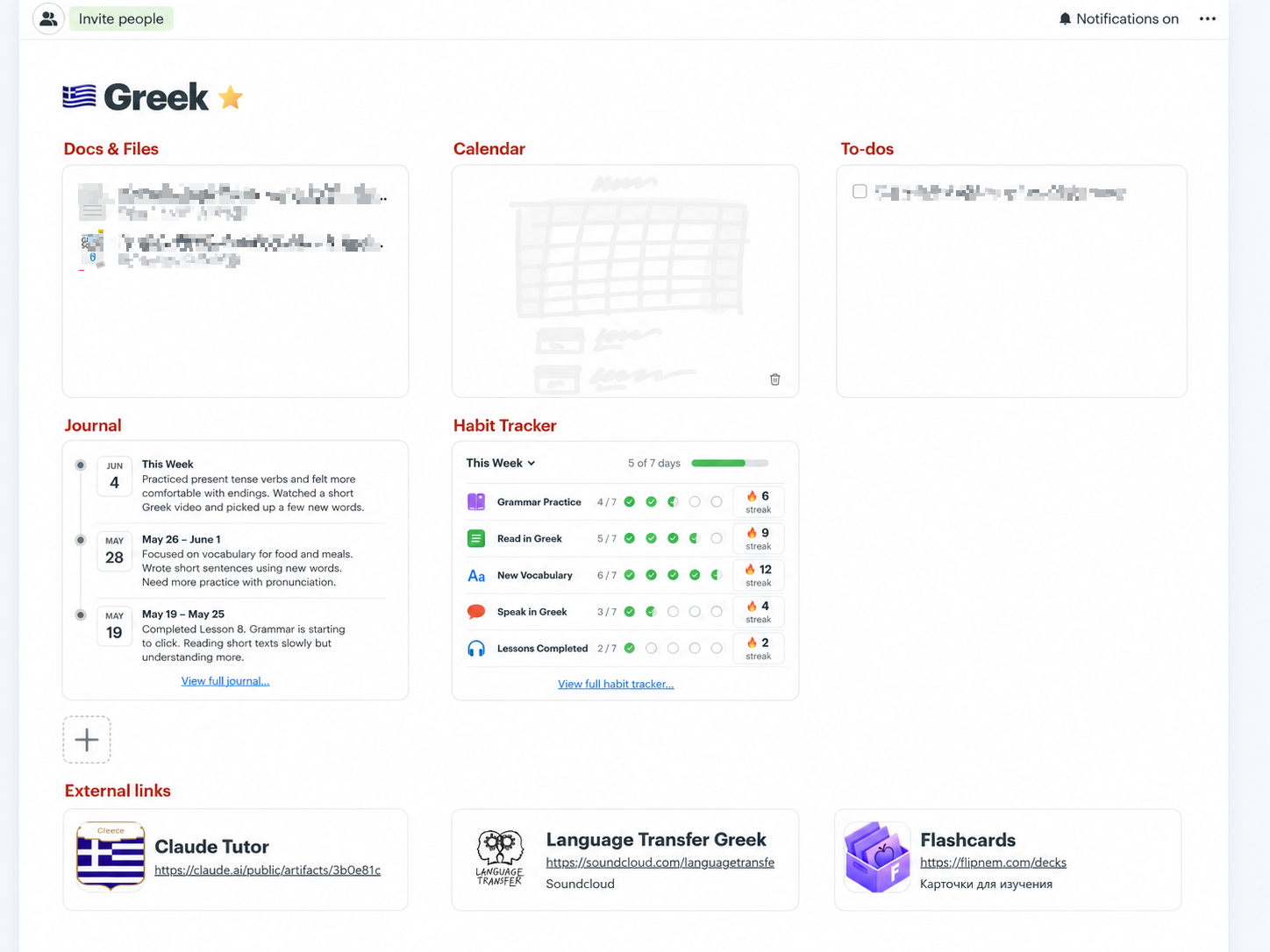
I understand that the whole metaphor of a base camp implies a group effort. But hey, a man can dream, right?