Cmd-Shift-C + Cmd-Shift-V

Arc has spoiled me with useful shortcuts. Cmd-Z to open the sidebar with tabs? Nice. Cmd-Shift-C to copy the current URL? Yes, please!

So when the Obsidian Web Clipper released its Reader view (magnificent, btw) I knew what I had to do.

Using a Raycast script, I added a second shortcut: Cmd-Shift-V, which opens the URL from my clipboard in Obsidian Reader View, in the browser of my choice.

And it works exactly like 👨‍🍳🤌💋

The Spandex Index

Superheroes are now so deeply entrenched in popular culture that their stories rarely feel surprising anymore. We know the costume, the secret identity, the moral code, the battle between good and evil. But was it always like this?

Writing these lines on a beach in Cyprus, I’m aware that ancient myths had already given us figures like Heracles, Achilles, Samson, and Gilgamesh: larger-than-life characters with extraordinary strength, divine origins, or heroic destinies. In many ways, they feel remarkably close to modern superheroes. But they were never called superheroes, and they did not belong to the cultural machinery that would later turn the superhero into a genre.

Robin Hood and Zorro also come to mind, but while they had the costumes, secret identities, heroic missions, and dramatic public personas, they lacked superpowers.

So: close, but no cigar.

The Golden Age of superhero comics in the US began at a very particular historical moment. Stories about heroic figures with extraordinary abilities were becoming a widespread genre just as the country was emerging from the Great Depression and entering World War II — a period marked by economic anxiety, political uncertainty, and hunger for symbols of strength, justice, and moral clarity.

It makes sense that many superheroes of that era (Superman, Batman, Captain Marvel, Wonder Woman, and Captain America) were written as clear heroic protagonists. They were defined less by inner conflict than by courage, duty, and an almost unwavering sense of right and wrong.

But after World War II, the cultural appetite began to shift. Superhero comic books gradually declined in popularity, and the industry came under increasing scrutiny. Fredric Wertham’s Seduction of the Innocent argued that comic books had a harmful effect on the children who read them, turning public concern into a moral panic. The issue became serious enough that the US Senate Subcommittee on Juvenile Delinquency held hearings on the possible link between comic books and juvenile crime.

So does this mean that the popularity of superhero stories depends on the zeitgeist?

Superheroes never really disappeared after World War II. They remained popular among certain audiences, especially comic-book readers and genre fans. But before Iron Man launched the Marvel Cinematic Universe’s triumphant rise in 2008, they had not yet become the dominant shared language of mainstream popular culture.

There had been major successes, of course. Sam Raimi’s Spider-Man films with Tobey Maguire were hugely popular, and Christopher Nolan’s Batman trilogy proved that superhero stories could be treated with seriousness and cinematic weight. But the MCU was something else entirely. Its scale, momentum, and cultural dominance — peaking, arguably, with Avengers: Infinity War in 2018 — put it in a different league.

So what was it? What was the spirit of that decade that made audiences so eager for superheroes again?

After the financial crisis of 2008, trust in institutions was fragile. Politics felt more unstable. The internet was no longer something we visited; it was becoming the atmosphere we lived inside, making everything faster, louder, and harder to process. The world seemed increasingly complex, while ordinary people often felt increasingly powerless within it.

And the new superheroes were different from their Golden Age predecessors. They were not pure symbols of moral clarity. They were wounded, arrogant, funny, lonely, traumatized, and frequently wrong. But when the moment came, they acted. They assembled. In that sense, the MCU did not simply bring superheroes back into the mainstream. It translated them for a decade that wanted power, yes, but also direction, teamwork, and the reassurance that chaos could still be met with courage.

Looking back now, though, after everything that has happened since 2018, those years no longer look quite as turbulent as they felt at the time.

Fittingly, the MCU’s decline began around the same time that The Boys in 2019, and then Invincible in 2021, pushed superhero stories into full genre deconstruction.

They leaned into the “what if” territory and asked what might actually happen if people had superpowers — if they were not automatically noble, wise, or morally prepared for them. What if power did not reveal heroism, but vanity, cruelty, insecurity, corruption, and the terrifying randomness of ordinary human impulses?

I haven’t finished Invincible yet, but The Boys finale felt sad in its own way. What started as a superhero parody quickly slipped into political satire, and then became a parody in and of itself.

Now, as we seem to be heading into another decade of uncertainty, I genuinely believe that no superheroes are coming to save us this time.

Yes, superpowers are a useful metaphor when you write about power imbalances, complicated moral choices, and the burden of having more agency than everyone around you. But a metaphor can only stay alive if it keeps changing. Once it becomes too familiar, it stops revealing anything new.

So maybe it is time to turn to something else for a while. I’m sure superheroes will return; they always do. But right now, it feels more exciting to explore other stories, to find inspiration and hope elsewhere.

Maybe the best stories right now are the ones without anyone strong enough to fix things.

Something New

It is alluring to try to monetize your writing, especially when you love doing it, like I do. But it is hard to monetize random ramblings, so over the years I have had several ideas for more comprehensive themes.

My latest disenchantment with tech makes it even harder for that theme to stick. It is no fun to write about tech when everything seems to be about AI, and you don’t even like AI that much.

I had another idea over the last week and played with multiple platforms to host it. Surprisingly, Substack looked the most promising, mostly because the audience felt right for the idea, and because they seem to have solved the discovery issue, in my opinion.

I went as far as creating a new publication, and I think it looks nice. However, after spending some time on the platform, it hit me that this is yet another social network — with its own algorithm, growth hacks, and many other things I hate.

So I decided to stick with what I already have: Pagecord. I simplified the theme and the name of my publication into a tag here: #wdsh.

This way, I’ll be able to control both the means of production — myself — and the flow of commerce, which is currently non-existent.

You’ll find the intro post below.

If you want to join me on this adventure, you can support me monthly on Ko-fi and add the RSS feed for this tag to your reader.


Artificial Intelligence is a marketing misnomer. It is artificial, no doubt. But is it intelligent?

They call these systems “AI” because the phrase is useful for them. It sells. It excites investors. It makes software feel almost alive. But what we are really dealing with is not a mind. It is software trained on vast amounts of human output, predicting what should come next based on patterns it has learned. But is that intelligence?

One can argue that the human brain also works something like this. We also rely on patterns, memory, previous experience, and things we have absorbed from the world. But there is still something about it that allows us to create, compose, and bring something new into this world. Something creative.

Yes, it is always based on something from the past. But it is still unique to each person. The same book, the same conversation, the same memory can become completely different things in different minds. Can the same be said about AI?

There is also that old saying: all stories have already been told. You can’t come up with anything completely new. Maybe. But who cares?

You don’t need to tell a completely new story. You need to tell your story. And that alone makes it different. The same plot, the same theme, the same conflict can become something else in another person’s hands. That is why we continue to write books and tell new stories. Even the words suggest it: novellas, novels.

Something new. Something human.

So how do writers find stories to write? Where do they get their ideas, and how?

Inspired by the latest post from Elif Shafak, I’m launching a new series in search of the answer to one simple question:

Where Do Stories Hide?

Quarter Past Whatever

OK, the deadline has passed, so I’m allowed to publish my entry for the 100-word microfiction challenge I wrote about earlier.

I didn’t make it to the second round, but it was still fun. The assignment was to write an original 100-word story in an assigned genre, include the assigned action, incorporate the assigned word, and do it all within 24 hours:

GROUP: 1
GENRE: Sci-Fi
ACTION: Bumping
WORD: brilliant

Without further ado:


The holographic screen flickered above everyone’s heads. It was quarter past whatever time was in space. People bumped into each other, eagerly waiting for the town hall to start—even though there was no town, no hall, no Earth. No blue skies, no red sunsets, no leafy smells, or sea sounds. None of that. Perished.

Quite the contrast with the metal and sweat surrounding them right now. The design of the generation ship was brilliant, actually. But it was not home.

The screen flickered once more, and they heard:

“As you may already know, my name is Noah.”

Two Moods

There are two moods in this world.

One is born on the beach. Think Mediterranean, Southeast Asia, South America. The warm sun is crawling across the sky above you. The air is heavy, and time is moving so slowly it feels like you can see it. You’re chilling and want something chill to go with it — think freddo espresso or cold lager. Something cold that tells your soul to take a day off.

The second comes to you in the dark. Think Nordic countries, Russia, the British Isles. The sky is gloomy, it’s raining or snowing outside, and the day feels like it never fully woke up. You want the opposite — something warm to savor. A good cuppa or hot chocolate. Something hot that warms your hands before it reaches your soul.

To be happy is to let them take turns.

Bad Writing, Good Lessons

When you’re an aspiring writer, you try to justify everything you write and put into your book. Every little thing needs its own reason to exist in the text. You try to think of everything.

Let’s take the 100-word writing challenge I participated in, for example. I didn’t get through to the second round, sadly, but it was a fun experience, and I’ll be able to publish my little story later this month. Stay tuned.

The feedback from the judges is strict. They judge every word, and you need to be able to answer for each one you put in your submission.

Then you sit down to watch some TV with your wife, and one of the main protagonists of a well-known TV show, in its fifth and final season, suddenly becomes an IT technician who understands CCTV wiring and can loop cameras by simply switching a cable — all to get inside a military base slash laboratory. This trope is well-worn, yet it is so strange to watch.

But I guess you can see such lazy writing from two angles. On the one hand, it’s quite upsetting to see this in one of the most watched TV shows right now. On the other hand, if this kind of writing is good enough for the big guys who made it, it means you can do it too.

It’s inspiring, really — in its own bad-writing, oddly reassuring, impostor-syndrome-relieving kind of way.

A Case Against Chat Support

My Apple Watch has been acting up ever since I changed the region of my Apple Account. The Apple Watch app refuses to download any music to the watch, no matter what I do.

So, as a tech support person myself, I decide to contact Apple Support about it.

Here is how it went:

  • We start at 15:15.
  • I share detailed information about the issue and the troubleshooting steps I have already tried.
  • I can’t upload a screen recording of the problem because their interface doesn’t support the file format.
  • They ask me questions about things I have already explained.
  • I get disconnected from the first advisor.
  • I get reconnected to a second advisor.
  • They take some time to check the conversation history.
  • They ask me the same questions again about things I have already shared.
  • I am asked a few more questions, and I reply with more details.
  • The advisor finds out that I have a VPN app installed on my iPhone and suggests uninstalling it, even though there are no active tunnel profiles. It isn’t the VPN.
  • It is 16:00.
  • The second advisor says they have run out of troubleshooting steps they can provide and suggest escalating the issue to phone support.
  • I share my timezone, phone number, and current country.
  • They then find out that phone support isn’t available in Cyprus.
  • By this point, it is 16:15. I have just spent an hour talking to someone in a chat interface who is no help at all and hasn’t moved the issue forward even an inch.
  • Their final suggestion is that I call the Tier 1 support hotline myself to escalate the issue to a Senior Advisor.

An hour later, I am exactly where I started — except now I also have a phone number to call.

I have no idea about their support structure. And most importantly, I have no idea why they can’t just escalate my issue further and reply to me via email, which feels like the sanest thing to do next.

But just imagine how much easier it would be with normal email support. How much more time-, cost-, and mentally efficient email is.

The moral of the story: choose email. Always.

I can’t believe how bad controlling Apple Music on an Apple Watch still is.

How is it that I can load music onto an iPod, rediscover it in a drawer 15 years later, and all my music is still there - but when I download a playlist to my watch to listen offline, it just randomly disappears from time to time? It is honestly mind blowing.

This happened again this morning, so I had to run with no music at all. Like a barbarian.

Why, Apple, why.

Pragmata

You know the ongoing joke about “brain rot content” where the main video plays on the left, and Subway Surfers runs on the right (or Minecraft in the background) because the modern brain can’t focus on just one thing?

We all do that now. That’s why you need multiple monitors, duh.

Lately, I’ve been also trying to leave my phone in another room, or at least out of arm’s reach, so I stop checking it during the “boring” parts of whatever we're watching.

I think Pragmata weaponizes this beautifully, turning it into an engaging combat system where you’re hacking enemy AI (by solving a mini puzzle) while dodging their attacks at the same time. And it works!

It’s a compact single-player game with an engaging story, and I really enjoyed finishing it over the past week.

In a nutshell:

https://bsky.app/profile/iamgregb.io/post/3mk6bgcku3c2w

The Little Arc of Browser History

The first mainstream browser, Mosaic, was released 33 years ago. A little earlier, in 1990, Tim Berners-Lee created the very first browser, WorldWideWeb. And if you look at it, there’s surprisingly little separating those early interfaces from the way modern browsers still look today.

Indeed, the feature set of a traditional browser hasn’t changed all that much since its inception in 1990. You can argue otherwise, but most additions over the years have been incremental rather than transformative. In my view, there have only been two genuinely big ideas: tabs and extensions. Everything else, bookmarks, history, toolbar, and so on, is essentially boilerplate, with the same interface patterns carried from one browser to another without a second thought.

I don’t ask much from my browser, and I definitely don’t need any baked-in AI features. I’m pretty content with the current feature set. What’s surprising, though, is how little fresh, thought-provoking thinking there’s been around the browser interface, and how we interact with it.

I’m not talking about AI assistants in so-called “agentic” browsers like Comet, Atlas, or Dia, or the half-baked AI sidebars showing up in the latest versions of Chrome, Firefox, Edge, or Brave. I don’t want to chat with my tabs, and I definitely don’t need yet another chat bar in my browser. As Julian Lehr puts it in his post The Case Against Conversational Interfaces:

A natural language prompt like “Hey Google, what’s the weather in San Francisco today?” just takes 10x longer than simply tapping the weather app on your homescreen.

What I mean are bold moves that rethink how we actually work in a browser, and how the browser works for us.

Enter Arc.

A product of its time (2023), when TBCNY hadn’t yet gone all-in on AI and wasn’t shy about taking ambitious swings at Chrome. It was full of genuinely innovative ideas. Not all of them stuck, of course, and some were eventually discontinued, like Arc Notes. Still, most were compelling, and I miss them every day.

I’m sure I’m not the only one who fell in love with vertical tabs because of Arc. Now every browser seems to be racing to replicate the experience. Chrome finally got them this month, in April 2026, but not a single implementation feels or works quite as well.

Swiping between separate workspaces with different profiles (!) was seamless, and I’m still surprised that no other browser has managed to reproduce this behavior.

Peek was a great way to skim Twitter and open linked articles without losing context. Easels, even though I didn’t use them much, offered an interesting take on whiteboarding that lived right in the browser. And Arc Max wasn’t just another chat bar with an AI assistant, it was a genuinely thoughtful, complementary use of AI within a modern interface.

With all that in mind, Little Arc is the feature I loved, and miss, the most. Just like Peek, it was a brilliant way to preview and triage links without opening the main browser window. Orion has a similar feature called Link Previews, but it doesn’t quite hit the same mark for me.

I believe this is why Arc became so popular and earned its cult-like status among users. It packed so many gems into one product. A glass of ice water in hell. But in his Letter to Arc members 2025, Josh Miller, the CEO of TBCNY, calls it the "novelty tax" problem and frames it as Arc’s main downside:

After a couple of years of building and shipping Arc, we started running into something we called the “novelty tax” problem. A lot of people loved Arc — if you’re here you might just be one of them — and we’d benefitted from consistent, organic growth since basically Day One. But for most people, Arc was simply too different, with too many new things to learn, for too little reward.

And I get that. When you’re set in your ways, it’s hard to adapt to something new. But I still don’t think Arc’s downfall came from its novelty or the sheer number of features. It came from something else entirely: VC money.

Once you take VC money, you’re expected to demonstrate constant growth, or else. Or you pivot to AI and suddenly it becomes much easier to raise more.

The state of web browsers in 2026 looks different: while the big players and AI-companies are busy adding AI everywhere, a new crop of smaller browsers - Orion, Helium, Horse, Zen, Pola, and others - trying to emerge and, at times, mimic a fraction of Arc’s power.

I understand that browsers like Google Chrome, Mozilla Firefox, and Safari serve millions of users every day, and that at this scale it’s hard to experiment. I understand the power of defaults and all that. But still, it’s hard not to feel disappointed by how little real interface innovation there is.

Arc showed us that something fresh is still possible. Unfortunately, it also showed that we’re all chasing the wrong things.

On Being Left Out

A teaser this week, yet another CLI and headless agent access from a software company I follow, finally crystallized my theory about why "AI" is so controversial. I don't think the latest LLM technology is inherently evil, but the way it's being used and promoted feels way off.

The visceral reaction that everyone a lot of people seem to have against AI isn't coming from a place of hate (though I'll admit, it's not coming from a place of love either). It's simpler than that - people feel left out.

Look at what's happening around you.

Every software company is building the same thing, and it increasingly feels like they've switched from creating software for people to building software for AI agents.

Every LLM is being trained on the work of real humans without giving anything back, and then used as an excuse to lay off more and more of those same people.

LLMs are being used to automate everything and flood the internet, the very thing that people loved, with bots and generated text, making the dead internet theory a reality faster than anyone thought possible.

Would the reaction be the same if software companies actually took a minute to implement AI features thoughtfully, without forgetting about their actual users - flesh and blood?

Would people still react this way if the copyright questions were handled with care; authors and artists were compensated properly; and people's productivity increased without them losing their jobs?

Would the backlash be the same if the effect AI has on the internet and interpersonal communication were positive?

I don't know, but there's a real chance it wouldn't. Because right now we all feel like gamers raised on NVIDIA graphics cards. We grew up with the technology we love, only to find out that we're no longer the customer the company cares about.

The Cookie Banner Saga

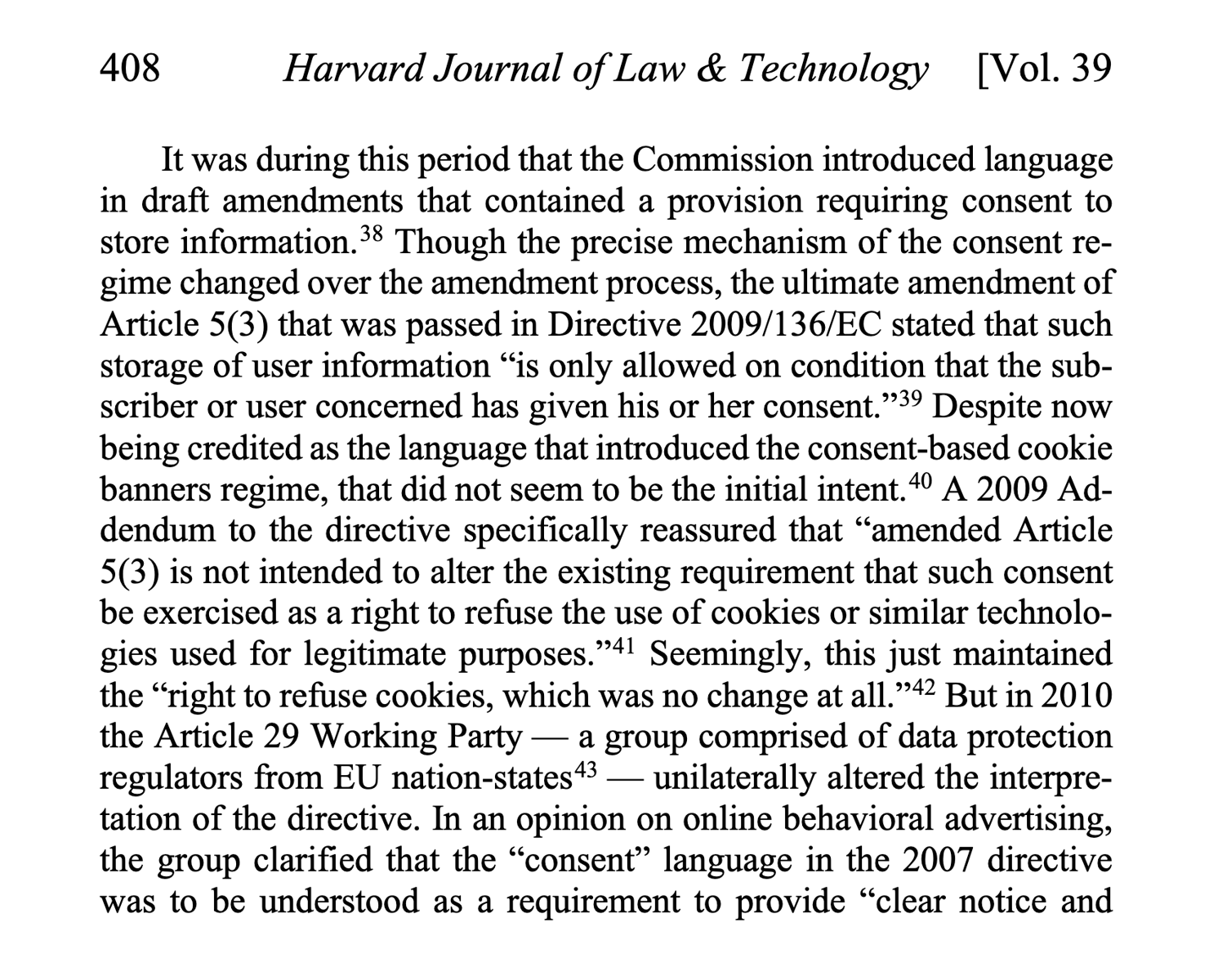
Back in November 2009, when I was a young 21-year-old studying linguistics at university - full of dreams and hopes about the upcoming winter exam period and the future, thinking about girls and stuff - the EU Parliament, Council, and Commission were busy introducing amendments to the ePrivacy Directive that would go on to ruin the internet forever:

Uploaded image
Journal page explaining how EU consent rules led to cookie banners

Can’t recommend this case study enough.

A great cri de coeur from Kate Klonick on abolishing cookie banners.

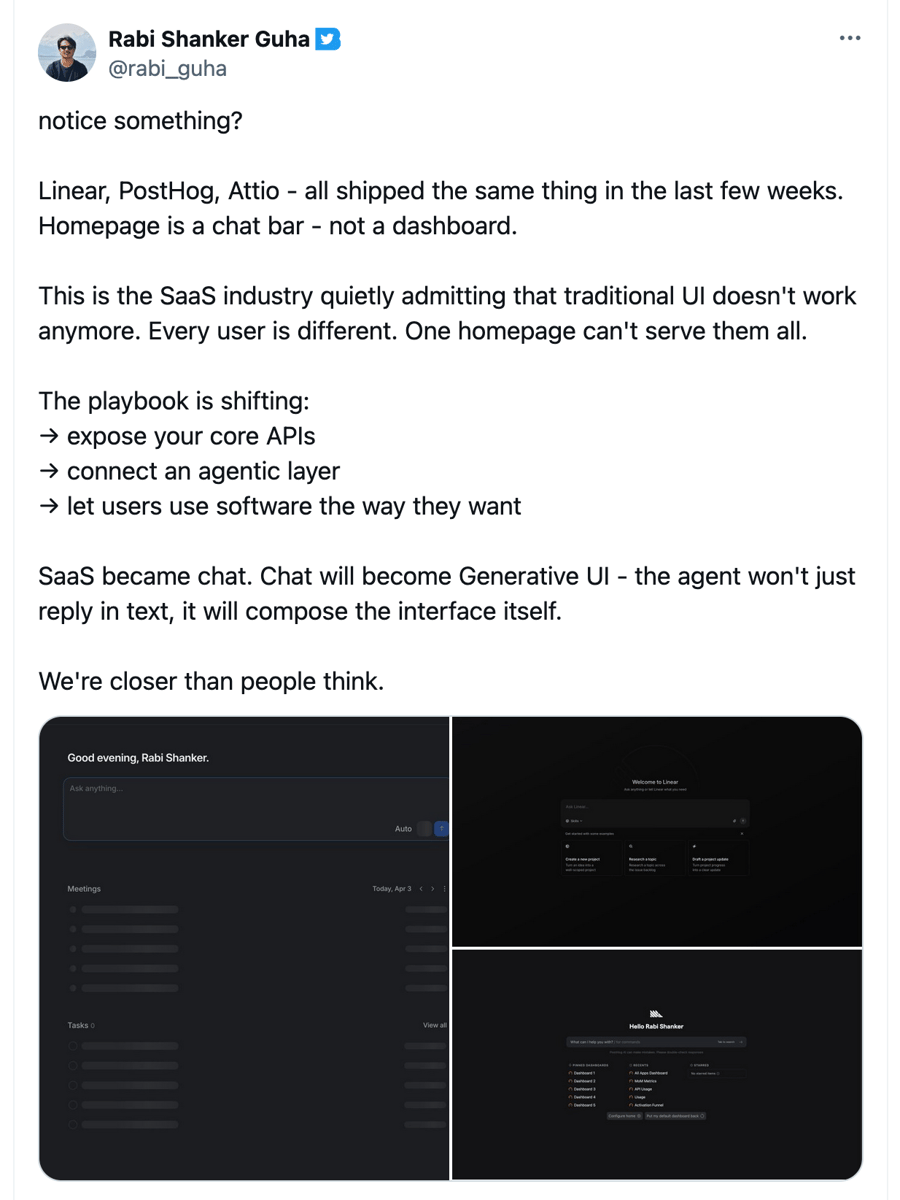
The Chat Bar Has Arrived

The moment I wrote about back in October 2024 has finally arrived.

Turns out, creativity wasn't required after all, so now everyone is just betting on the same thing - the chat bar:

Uploaded image
A screenshot of a tweet about the Chat Bar in Linear, PostHog, Attio

What a sad state of software, really. Instead of useful dashboards or UIs you've memorized and can navigate in a couple of clicks, you now get a dull chat bar where you have to ask a question first.

It's funny how the IT guys, the most introverted crowd, are building the most extroverted thing of all: something where you have to talk all day long.

Design Update

Revamped my blog design entirely.

The main page is now the feed of my posts. This way the site will feel more alive and dynamic, if I post regularly, though.

Added some custom CSS too, with little markers to distinguish #now and #fiction posts in the feed. I think it looks nice.

You're missing out if you're only reading this in RSS!